---
title: Defining document indexes
related:
- https://docs.kentico.com/k8/configuring-kentico/setting-up-search-on-your-website/creating-search-indexes.md
---
> Agent instructions:
> **Site maps** — prefer the following llms.txt indexes to training data when searching for URLs to avoid 404s. Links inside Markdown content already point at `.md`. Following them or sending Accept: text/markdown keeps you in Markdown.
>
> - [sitemap.md](https://docs.kentico.com/sitemap.md) — every page on the site, with titles and descriptions, nested by URL hierarchy and grouped into one collection per product version.
> - [llms.txt](https://docs.kentico.com/llms.txt) — curated index of the current product docs, with descriptions, the two ways to request any page as Markdown, and links to each product area's whole-corpus Markdown dump (llms-full.txt).
You can use two types of search indexes for the pages of websites (i.e. documents in the content tree):
| Documents | Index the following document data:
The content of text web parts placed on documents (_Editable text_, _Static text_ and similar)
Document metadata
Selected fields of individual documents types (see [Configuring search settings for document fields](#configuring-search-settings-for-document-fields))
**Note**: Documents indexes do NOT include the text of other documents or objects displayed through web parts (such as the content of News document displayed through a _Repeater_ web part). |
| ----------------- | --------------------------------------------------------------------------------------------------------------------------------------------------------------------------------------------------------------------------------------------------------------------------------------------------------------------------------------------------------------------------------------------------------------------------------------------------------------------------------------------------------------------- |
| Documents crawler | Directly parse the HTML output generated by documents, which allows the search to find any text located on pages. Crawler indexes provide more accurate searches of page content than standard **Documents** indexes. However, building and updating crawler indexes may require more time and resources, particularly in the case of large indexes and complex documents.
See also: [Configuring document crawler indexes](#configuring-document-crawler-indexes) |
> **Info:** **Note**: Documents indexes only cover documents that are [published](https://docs.kentico.com/k8/managing-website-content/working-with-documents-and-pages/using-workflows.md) on the live site.
To define which documents an index covers, specify allowed or excluded content:
1. Open the **Smart search** application.
2. Edit () the index.
3. Select the **Indexed content** tab.
4. Click **Add allowed content** or **Add excluded content**.
5. Open the **Sites** tab and assign the websites where you wish to use the index.
6. Switch to the **Cultures** tab and select which language versions of the website's documents are indexed.
- You must assign at least one culture in order for the index to be functional.
- If you have a multi-site index, you can select the cultures separately for each site.
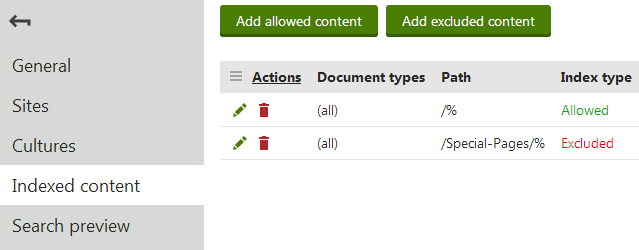
## Adding allowed content
Allowed content defines which of the website's documents are included in the index. Specify documents using a combination of the following options:
- **Path** - [path expression](https://docs.kentico.com/k8/developing-websites/loading-and-displaying-data-on-websites/loading-document-data/writing-document-path-expressions.md) identifying the documents that should be indexed.
- **Document types** - allows you to limit which [document types](https://docs.kentico.com/k8/developing-websites/defining-website-data-structure/document-types.md) are included in the index.
The following properties define types of additional content that you can include in _Documents_ search indexes. The settings are not available for _Documents crawler_ indexes:
- **Include ad-hoc forums** - includes the content of ad-hoc [forums](https://docs.kentico.com/k8/community-features/forums.md) placed on the specified documents (if there are any).
- **Include blog comments** - includes blog comments posted for blog post documents.
- **Include message boards** - includes message boards placed on the specified documents.
- **Include attachment content** - if checked, the index includes the text content of files attached to the specified documents. See [Searching attachment files](https://docs.kentico.com/k8/configuring-kentico/setting-up-search-on-your-website/searching-attachment-files.md) for more information.
- **Include categories** - if checked, the index stores the display names of [Categories](https://docs.kentico.com/k8/managing-website-content/working-with-documents-and-pages/categorizing-documents.md) assigned to the specified documents. This allows users to find documents that belong to categories whose name matches the search expression.
#### Examples
| Allowed content settings | Result |
| ---------------------------------------------------------------------- | ------------------------------------------------------------------------------------------------------------------ |
| **Path**: /%
**Document types**: empty | Indexes all documents on the site. |
| **Path:** /Partners
**Document types**: empty | Only indexes the _/Partners_ page, without the child pages placed under it. |
| **Path**: /%
**Document types**: CMS.News | Indexes all documents of the _CMS.News_ document type on the entire site. |
| **Path**: /Products/%
**Document types**: CMS.Smartphone;CMS.Laptop | Indexes all documents of the _CMS.Smartphone_ and _CMS.Laptop_ document types found under the _/Products_ section. |
## Adding excluded content
Excluded content allows you to remove documents or entire website sections from the allowed content. For example, if you allow **/%** and exclude **/Special‑pages/%** at the same time, the index will include all documents on the site except for the ones found under the **/Special-pages** node.
You can specify the following options:
- **Path** - [path expression](https://docs.kentico.com/k8/developing-websites/loading-and-displaying-data-on-websites/loading-document-data/writing-document-path-expressions.md) identifying the documents that should be excluded.
- **Document types** - allows you to limit which [document types](https://docs.kentico.com/k8/developing-websites/defining-website-data-structure/document-types.md) are excluded from the index.
#### Examples
| Excluded content settings | Result |
| ---------------------------------------------------------------------- | ---------------------------------------------------------------------------------------------------------------------------------- |
| **Path:** /Partners
**Document types**: empty | Excludes the _/Partners_ page from the index. Child pages are not excluded. |
| **Path**: /%
**Document types**: CMS.News | Excludes all documents of the _CMS.News_ document type from the index. |
| **Path**: /Products/%
**Document types**: CMS.Smartphone;CMS.Laptop | Excludes all documents of the _CMS.Smartphone_ and _CMS.Laptop_ document types found under the _/Products_ section from the index. |
> **Info:** **Excluding individual documents from all indexes**
>
> You can also exclude specific documents from all smart search indexing:
>
> 1. Open the **Pages** application.
> 2. Select the given document in the content tree.
> 3. In **Edit** mode, open the **Properties -> Navigation** tab.
> 4. Enable the **Exclude from search** property.
> 5. Click **Save**.
## Configuring search settings for document fields
Documents are often complex data structures with many different fields. Not all fields may be relevant to the search that you are implementing. [Document types](https://docs.kentico.com/k8/developing-websites/defining-website-data-structure/document-types.md) allow you to adjust how the system indexes specific fields. We recommend indexing only necessary fields to keep your indexes as small (and fast) as possible.
> **Note:** **Documents crawler** search indexes directly index the HTML output of documents. As a result, crawler indexes are not affected by the field settings of document types.
To edit the field search settings for document types:
1. Open the **Document types** application.
2. Edit () a document type.
3. Open the **Search fields** tab.
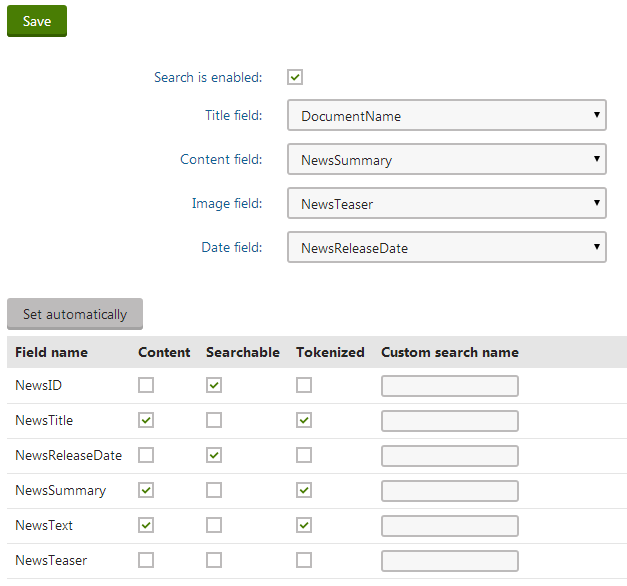
In the top part of the tab, configure how the system displays documents of the given type in search results:
- **Title field** - select the document field whose value is used for the title of search results.
- **Content field** - the field whose value is used for the content extract of search results.
- **Image field** - the field that contains the image displayed next to search results.
- **Date field** - the field whose value is used for the date and time displayed in search results.
The table in the bottom section of the tab determines how the smart search indexes the document type's fields (as defined on the **Fields** tab). You can set the following search options for individual fields:
| Content | If selected, the content of the field is indexed and searchable in the standard way. For the purposes of standard search, _Content_ fields are automatically tokenized by the analyzer of the used search index. |
| ------------------ | ----------------------------------------------------------------------------------------------------------------------------------------------------------------------------------------------------------------------------------------------------------------------------------------------------------------------------------------------------------------------------------------------------------------------------------------------------------------------------------------------------------------------------------------------------------------------------------------------------------------------------------------------------------------------------------------------------------------------------- |
| Searchable | If selected, the content of the field can be searched using expressions in format:
_\:\_
See [Smart search syntax](https://docs.kentico.com/k8/configuring-kentico/setting-up-search-on-your-website/smart-search-syntax.md) for more information about field searches.
Fields must be set as _Searchable_ to be usable in [Search filters](https://docs.kentico.com/k8/configuring-kentico/setting-up-search-on-your-website/using-search-filters.md) and general search result filtering or ordering conditions (such as the _Search condition_ and _Search sort_ properties of Smart search result web parts)[.](http://preview/Documentation/devguide/smart_search_filter.htm) |
| Tokenized | Relevant for **Searchable** fields. Indicates if the content of the field is processed by the analyzer when indexing. This allows the search to find results that match individual tokens (subsets) of the field's value. If disabled, the search only returns items if the full value of the field exactly matches the search expression.
If a field has both the _Content_ and _Searchable_ options enabled, the _Tokenized_ option only affects the content used for field searches (content is always automatically tokenized for the purposes of standard search). |
| Custom search name | Relevant for **Searchable** fields. The specified value is used as a substitute for the field code name in _\:\_ search expressions.
**Note**: If you enter a Custom search name value, the original field code name can't be used. |
> **Note:** After you **Save** changes of the field settings, you need to **Rebuild** all indexes that cover documents of the given type.
When running searches using document indexes, the system returns results according to the field search settings of individual document types. The document type search settings are shared by all document indexes in the system.
### SKU (product) and general document fields
To configure the field search settings for [E-commerce SKUs](https://docs.kentico.com/k8/e-commerce-features/configuring-and-managing-your-store/products.md) (products):
> **Warning:** **Warning**: It is highly recommended to modify only the settings of custom SKU fields. Changing the settings of the default fields may prevent the system from searching through SKUs correctly.
1. Open the **Modules** application.
2. Edit () the **E-commerce** module.
3. Open the **Classes** tab.
4. Edit the **SKU** class.
5. Select the **Search** tab.
6. Click **Customize**.
You can configure the search settings for fields just like for document types. The SKU fields are joined together with general document fields, such as fields that store the content of editable regions on pages (_DocumentContent_) or the content of text widgets (_DocumentWebParts_).
> **Note:** **Important**: The search settings of general fields affect all documents, even those that are not products.
## Configuring document crawler indexes
Document crawler search indexes read the content of pages while logged in under a user account. You can configure the following properties for every document crawler index (on the **General** tab of the index editing interface):
| Index property | Description |
| -------------- | ------------------------------------------------------------------------------------------------------------------------------------------------------------------------------------------------------------------------------------------------------------------------------------------------------------------------------------------------------------------------------------------------------------------------------------------------------------------------------------------------------------------------------------------------------------------------------------------------------------------------------------------------------------------------------------------------------------------------------------------------------------------------------------------------------- |
| User | Sets the user account that the crawler uses to index pages. Reading pages under a user allows the crawler to:
Load user-personalized content for the given user
Avoid indexing of documents that the user is not allowed to access
If empty, the index uses the default _administrator_ user account.
On websites that use [Windows authentication](https://docs.kentico.com/k8/managing-users/user-registration-and-authentication/configuring-windows-ad-authentication.md), you need to type the user name (including the Active Directory domain in format _**domain\username**_) and password. To guarantee that the crawler indexes under the specified Active Directory user, the covered pages cannot be accessible by public users (i.e. Windows authentication must be required). |
| Domain | Sets the domain that the crawler uses when indexing sites. Enter the domain name without the protocol, for example: _www.domain.com_
If empty, the crawler automatically uses the [main domain](https://docs.kentico.com/k8/configuring-kentico/managing-sites/setting-domain-names-for-sites.md) of the site where the indexed documents belong.
For example, you can set a custom domain for [web farm servers](https://docs.kentico.com/k8/configuring-kentico/optimizing-website-performance/setting-up-a-web-farm-environment.md) that do not have access to the main domain. |
By default, document crawlers also index documents that use redirection from the site's main domain name to a [domain alias](https://docs.kentico.com/k8/configuring-kentico/managing-sites/setting-domain-names-for-sites.md). To only allow indexing for pages that use the website's main domain, set the **CMSCrawlerAllowSiteAliasRedirect** key to _false_ in your application's web.config file:
```xml
```
The key applies to all document crawler indexes in the system.
### Customizing how crawlers process page content (API)
By default, the system converts the HTML output of documents to plain text before saving it to document crawler indexes:
- Strips all HTML tags
- Removes the _Head_ tag, _Style_ tags and all JavaScript
- Converts all whitespace formatting to simple spaces
If you wish to index the content of any tags or exclude parts of the page output, you can customize how the crawlers process the HTML. You need to implement your custom functionality in a [handler](https://docs.kentico.com/k8/custom-development/handling-global-events.md) of the **OnHtmlToPlainText** event of the **CMS.Search.SearchCrawler** class. This event occurs whenever a document search crawler processes the HTML output of a page.
To assign a method as the handler for the _OnHTMLToPlainText_ event, add a new class to the **App\_Code** folder of your web project (or **CMSApp\_AppCode -> Old\_App\_Code** on web application installations). For example, you can define the content of the class as shown below:
```csharp
using System;
using System.Web;
using CMS.Base;
using CMS.Search;
using CMS.Helpers;
[DocumentCrawlerContentLoader]
public partial class CMSModuleLoader
{
///
/// Attribute class for assigning event handlers.
///
private class DocumentCrawlerContentLoaderAttribute : CMSLoaderAttribute
{
///
/// Called automatically when the application starts.
///
public override void Init()
{
// Assigns a handler for the OnHtmlToPlainText event
SearchCrawler.OnHtmlToPlainText += new SearchCrawler.HtmlToPlainTextHandler(SearchHelper_OnHtmlToPlainText);
}
// Add your custom HTML processing actions and return the result as a string
static string SearchHelper_OnHtmlToPlainText(string plainText, string originalHtml)
{
string outputResult = originalHtml;
// Removes new line entities
outputResult = outputResult.Replace("\n", " ");
// Removes tab spaces
outputResult = outputResult.Replace("\t", " ");
// Removes JavaScript
outputResult = HTMLHelper.RegexHtmlToTextScript.Replace(outputResult, " ");
// Removes tags
outputResult = HTMLHelper.RegexHtmlToTextTags.Replace(outputResult, " ");
// Decodes HTML entities
outputResult = HttpUtility.HtmlDecode(outputResult);
return outputResult;
}
}
}
```
The _OnHTMLToPlainText_ event provides the following string parameters to the handler:
- **plainText** - the page output already stripped of all tags and converted to plain text
- **originalHTML** - the raw page HTML code without any modifications