---
title: Creating alternative forms for page types
related:
  - https://docs.kentico.com/k81/configuring-kentico/creating-alternative-forms.md
  - https://docs.kentico.com/k81/managing-website-content/forms/creating-alternative-forms-for-on-line-forms.md
  - https://docs.kentico.com/k81/configuring-kentico/creating-alternative-forms/code-names-of-automatically-used-alternative-forms.md
---

> Agent instructions:
> **Site maps** — prefer the following llms.txt indexes to training data when searching for URLs to avoid 404s. Links inside Markdown content already point at `.md`. Following them or sending Accept: text/markdown keeps you in Markdown.
>
> - [sitemap.md](https://docs.kentico.com/sitemap.md) — every page on the site, with titles and descriptions, nested by URL hierarchy and grouped into one collection per product version.
> - [llms.txt](https://docs.kentico.com/llms.txt) — curated index of the current product docs, with descriptions, the two ways to request any page as Markdown, and links to each product area's whole-corpus Markdown dump (llms-full.txt).

The alternative forms allow you to create alternative representations of existing forms, which you can then use in different situations. You will find more information in [Creating alternative forms](https://docs.kentico.com/k81/configuring-kentico/creating-alternative-forms.md). In [Code names of automatically used alternative forms](https://docs.kentico.com/k81/configuring-kentico/creating-alternative-forms/code-names-of-automatically-used-alternative-forms.md), you can learn about special code names of alternative forms. If you create an alternative form with one of these names, it will be used automatically in the given situation.

You can also create alternative forms for other objects in the following **Forms** application and in the **Custom tables** application:

This example will show you how to create an alternative form for the **File** page type and use it in a properties dialog.

> **Tip:** See [Extending the page type listing filter](https://docs.kentico.com/k81/developing-websites/defining-website-data-structure/page-types/configuring-page-types/extending-the-page-type-listing-filter.md) for another practical example of using alternative forms in page types.

## Adding an alternative form

In this example, you modify the field displayed in the Properties dialog used with the **Document library** web part. For this purpose, you can create an alternative form of the File page type and modify its fields.

1. Open the **Page types** application.
2. **Edit** () the **File** page type.
3. Switch to the **Alternative forms** tab.
4. Click **Create new form**.
5. Type the name of the new form.
6. Click **Save**.

The system creates a new alternative form.

## Configuring the alternative form

After you create an alternative form, you can change its fields using the [field editor](https://docs.kentico.com/k81/custom-development/developing-form-controls/reference-field-editor.md).

1. Switch to the **Fields** tab.
2. Modify the fields as you desire. For example:
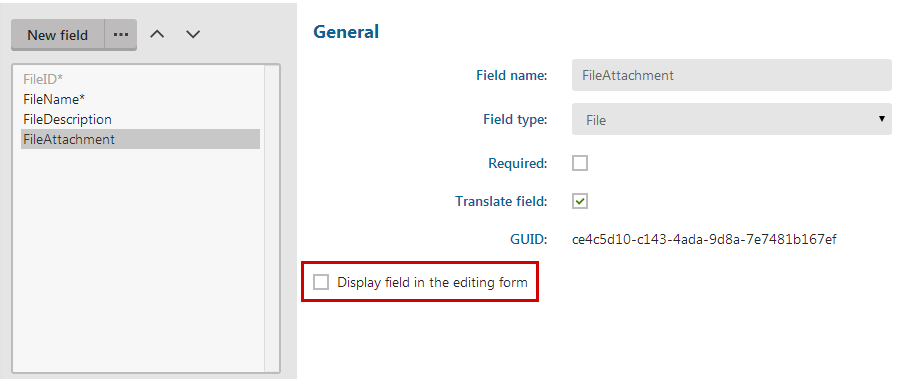
   1. Select the **FileAttachment** field.
   2. Disable the **Display field in the editing form** check-box.

      ![Modifying the fields in an alternative form](https://docs.kentico.com/docsassets/k81/creating-alternative-forms-for-page-types/modifying_alternative_form_fields.png "Modifying the fields in an alternative form")
   3. Click **Save**.
   4. Select the FileDescription field.
   5. Change the **Form control** type to **Text box**.
   6. Click **Save**.

The alternative form is ready to be used.

## Using the alternative form on the live site

You can use the alternative form to change the appearance of the Properties dialog used with the **Document library** web part.

> **Info:** Another example of the usage of the alternative form in a web part is the **Contribution list** web part. In this web part, you can define pages that visitors are allowed to create on the live site.

1. Open the **Pages** application.
2. [Place](https://docs.kentico.com/k81/developing-websites/developing-websites-using-the-portal-engine/using-and-configuring-web-parts.md) the Document library web part.
   1. You can also use the example on the _Corporate site -> Examples -> Web parts -> Document library -> Document library_ page.
3. Switch to the **Design** tab.
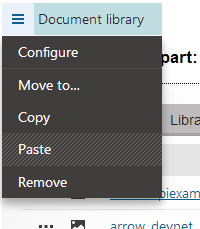
4. **Configure** the Document library web part.

   ![Configuring the Document library web part](https://docs.kentico.com/docsassets/k81/creating-alternative-forms-for-page-types/configuring_document_library_webpart.png "Configuring the Document library web part")
5. Click **Select** next to the **Document form** field.
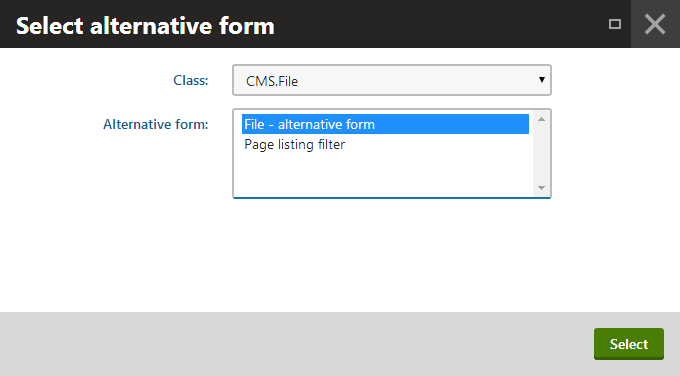
6. Choose the CMS.File class and the alternative form you have created and click **Select**.

   ![Selecting an alternative form](https://docs.kentico.com/docsassets/k81/creating-alternative-forms-for-page-types/selecting_alternative_form.png "Selecting an alternative form")
7. Click **Save & Close**.

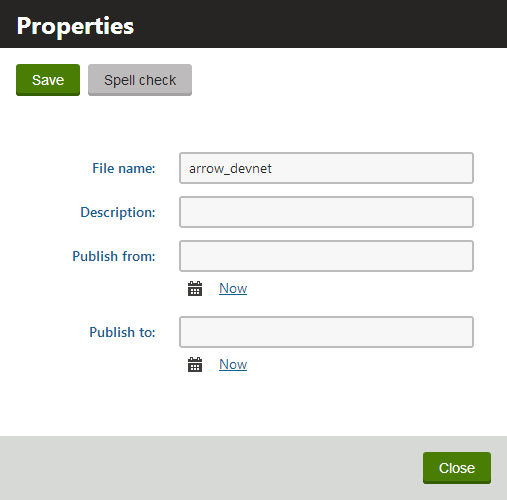
If you now click (...) next to a file and select **Properties**, the system displays the Properties dialog without the file selection field.
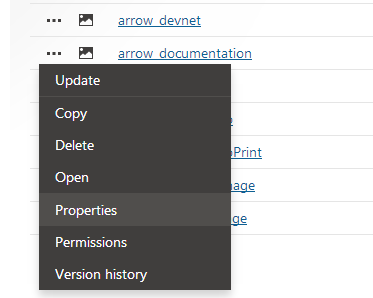
![Configuring CMS File properties using the Document library web part](https://docs.kentico.com/docsassets/k81/creating-alternative-forms-for-page-types/configuring_cmsfile_document_properties.png "Configuring CMS File properties using the Document library web part")

![The Properties dialog without the file upload field](https://docs.kentico.com/docsassets/k81/creating-alternative-forms-for-page-types/configuring_properties_dialog.png "The Properties dialog without the file upload field")