---
title: Defining on-line form indexes
related:
  - https://docs.kentico.com/k81/managing-website-content/forms.md
  - https://docs.kentico.com/k81/configuring-kentico/setting-up-search-on-your-website/creating-search-indexes.md
  - https://docs.kentico.com/k81/configuring-kentico/setting-up-search-on-your-website/displaying-search-results-using-transformations.md
---

> Agent instructions:
> **Site maps** — prefer the following llms.txt indexes to training data when searching for URLs to avoid 404s. Links inside Markdown content already point at `.md`. Following them or sending Accept: text/markdown keeps you in Markdown.
>
> - [sitemap.md](https://docs.kentico.com/sitemap.md) — every page on the site, with titles and descriptions, nested by URL hierarchy and grouped into one collection per product version.
> - [llms.txt](https://docs.kentico.com/llms.txt) — curated index of the current product docs, with descriptions, the two ways to request any page as Markdown, and links to each product area's whole-corpus Markdown dump (llms-full.txt).

On-line form indexes allow you to search through the data that website visitors submit through [forms](https://docs.kentico.com/k81/managing-website-content/forms.md).

## Adding forms to indexes

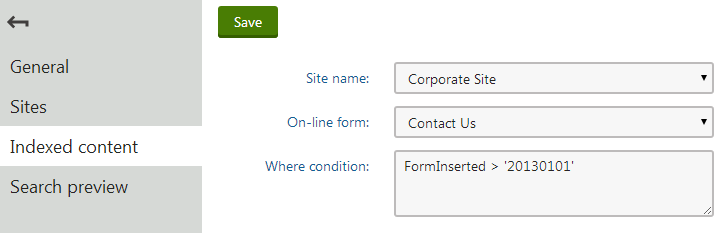
After you [create](https://docs.kentico.com/k81/configuring-kentico/setting-up-search-on-your-website/creating-search-indexes.md) an _on-line form_ index in the **Smart search** application, define which forms the index includes:

1. Assign the index to one or more websites on the **Sites** tab of the index editing interface.
2. Open the **Indexed content** tab and click **Add on-line form**.

   1. Select the **Site** that contains the required form (if the index is assigned to multiple websites).
   2. Select the **On-line form**.
   3. (Optional) Set a **Where condition** for the queries that the system uses to load the form's data when building the index. Allows you to limit which form records are included in the search index.
   4. Click **Save**.

> **Info:** You can add any number of forms to a single on-line form index.

3. Switch to the **General** tab and **Rebuild** the index.

You can now assign the index to [Smart search web parts](https://docs.kentico.com/k81/configuring-kentico/setting-up-search-on-your-website/adding-search-functionality-to-pages.md) and search through the data of forms.

![Adding a form to a search index](https://docs.kentico.com/docsassets/k81/defining-on-line-form-indexes/Indexed_Content_Forms.png "Adding a form to a search index")

## Configuring search settings for form fields

Each form has a different set of fields and stores different types of data. You can configure exactly how the system searches through the fields of individual forms and how the form data appears in the search results. We recommend indexing only necessary fields to keep your indexes as small (and fast) as possible.

1. Open the **Forms** application.
2. Edit () the form that you want to configure.
3. Open the **Search fields** tab.
4. Make sure that the **Search is enabled** box is checked.
5. Specify how the system displays the form's records in search results:

   - **Title field** - select the form field whose value is used for the title of search results.
   - **Content field** - the field whose value is used for the content extract of search results.
   - **Image field** - the field that contains the image displayed next to search results.
   - **Date field** - the field whose value is used for the date and time displayed in search results.
6. Configure how the smart search indexes the form's fields. You can set the following options for individual fields:

   | Content            | If selected, the content of the field is indexed and searchable in the standard way. For the purposes of standard search, _Content_ fields are automatically tokenized by the analyzer of the used search index.                                                                                                                                                                                                                                                                                                                                                                                                                                                                            |
   | ------------------ | ------------------------------------------------------------------------------------------------------------------------------------------------------------------------------------------------------------------------------------------------------------------------------------------------------------------------------------------------------------------------------------------------------------------------------------------------------------------------------------------------------------------------------------------------------------------------------------------------------------------------------------------------------------------------------------------- |
   | Searchable         | If selected, the content of the field can be searched using expressions in format:<br>_:_<br>See [Smart search syntax](https://docs.kentico.com/k81/configuring-kentico/setting-up-search-on-your-website/smart-search-syntax.md) for more information about field searches.<br>Fields must be set as _Searchable_ to be usable in [Search filters](https://docs.kentico.com/k81/configuring-kentico/setting-up-search-on-your-website/using-search-filters.md) and general search result filtering or ordering conditions (such as the _Search condition_ and _Search sort_ properties of Smart search result web parts)[.](http://preview/Documentation/devguide/smart_search_filter.htm) |
   | Tokenized          | Relevant for **Searchable** fields. Indicates if the content of the field is processed by the analyzer when indexing. This allows the search to find results that match individual tokens (subsets) of the field's value. If disabled, the search only returns items if the full value of the field exactly matches the search expression.<br>If a field has both the _Content_ and _Searchable_ options enabled, the _Tokenized_ option only affects the content used for field searches (content is always automatically tokenized for the purposes of standard search).                                                                                                                  |
   | Custom search name | Relevant for **Searchable** fields. The specified value is used as a substitute for the field code name in _:_ search expressions.<br>**Note**: If you enter a Custom search name value, the original field code name can't be used.                                                                                                                                                                                                                                                                                                                                                                                                                                                        |
7. Click **Save**.
8. **Rebuild** all indexes that contain the given form.

When running searches using on-line form indexes, the system returns results according to the field search settings of individual forms.